Events
Thursday, May 14, 2026
14 May 2026
Fountain University Hosts Research Capacity Building Programme to Strengthen Global Academic Engagement
The Centre for Research, Innovation and Technology (FUCRIT) of Fountain University, Osogbo, has organized the second edition of its Research and Innovation Capacity Building Programme, brin...
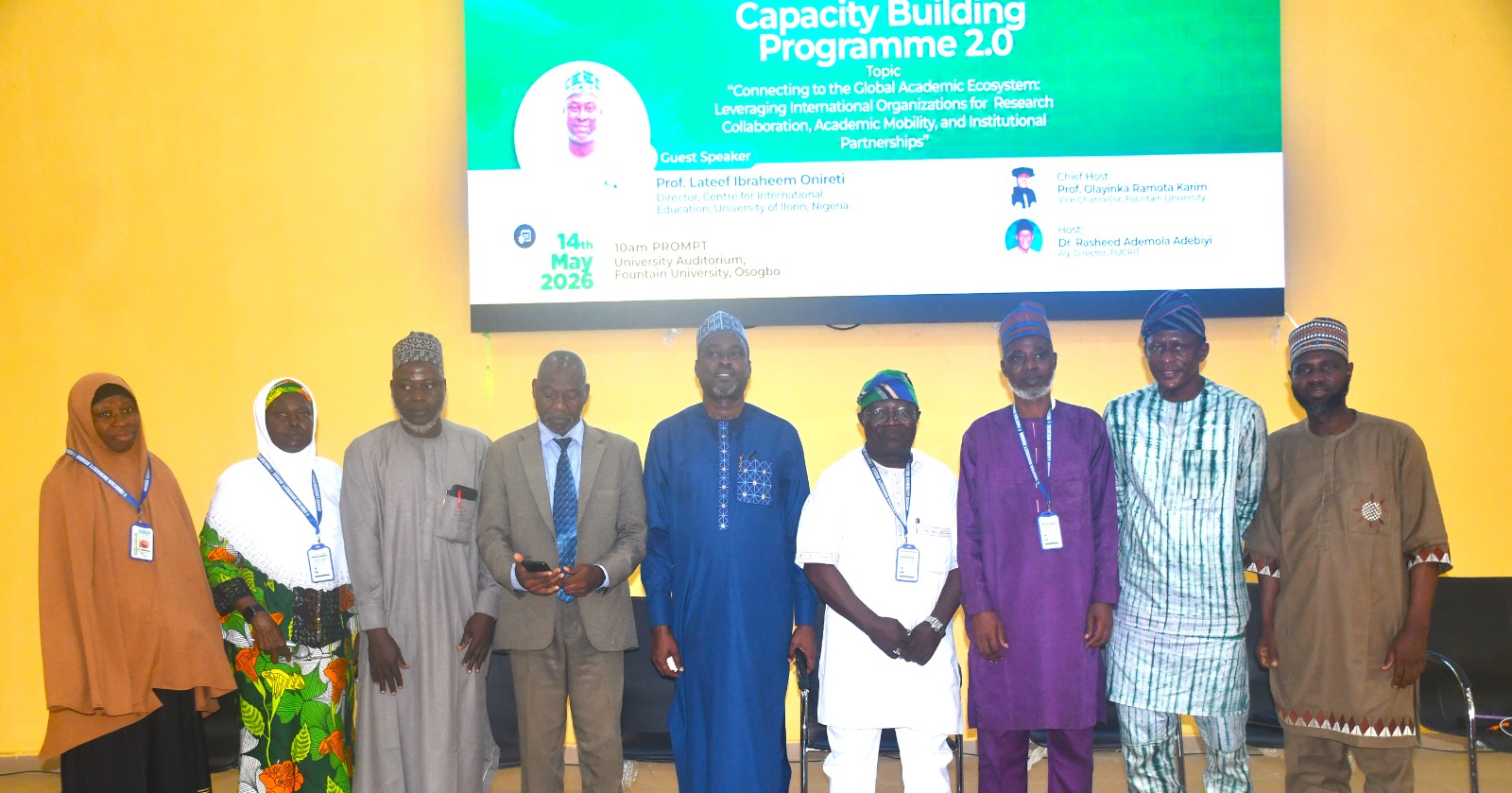
The Centre for Research, Innovation and Technology (FUCRIT) of Fountain University, Osogbo, has organized the second edition of its Research and Innovation Capacity Building Programme, bringing together academics, researchers, management staff, and students for robust discussions on global academic collaboration and institutional advancement.
The programme, which was held earlier today on campus, was hosted under the leadership of the Acting Director of FUCRIT, Dr Rasheed Adebiyi, and attracted members of the University Management led by the Vice-Chancellor, Prof. Olayinka Ramota Karim, alongside staff and students from various departments.
The keynote lecture was delivered by Prof. Lateef Ibraheem Onireti of the University of Ilorin, who spoke extensively on the theme: “Connecting to the Global Academic Ecosystem: Leveraging Internationalisation for Research Collaboration, Academic Mobility, and Institutional Partnerships.”
In her opening remarks, the Vice-Chancellor described the programme as another important step in the University’s commitment to academic excellence, innovative research, and global engagement. She commended the Acting Director of FUCRIT and his team for organizing what she termed an impactful initiative aimed at strengthening research and innovation within the institution.
Prof. Karim emphasized that the programme’s theme was both timely and relevant, noting that universities in today’s interconnected world must build strong international networks to improve research output, innovation, visibility, and institutional relevance. She further stated that collaborations with international organizations, research institutions, and funding agencies create opportunities for joint research, academic exchange, grants, innovation development, and global visibility.
The Vice-Chancellor encouraged participants to maximize the opportunities presented by the programme through active engagement, networking, and exploration of future collaborations, stressing that research and innovation remain critical tools for national development.
Delivering the keynote lecture, Prof. Onireti highlighted the growing transformation of the global higher education landscape, explaining that universities are no longer isolated institutions operating within national boundaries, but interconnected actors within a wider global academic ecosystem.
He explained that internationalisation in higher education encompasses student exchange programmes, faculty mobility, international research collaboration, joint degree programmes, international curriculum development, cross-border online learning, institutional partnerships, and participation in international conferences and workshops.
The scholar further underscored the importance of research collaboration, describing it as cooperative academic engagement aimed at producing knowledge, solving societal problems, and advancing innovation through joint projects, co-authorship, international grants, laboratory partnerships, and interdisciplinary networks.
Speaking on the benefits of international collaboration, Prof. Onireti noted that global academic partnerships increase access to funding opportunities, improve research visibility, facilitate knowledge transfer, and encourage interdisciplinary innovation. He cited organizations such as UNESCO, the British Council, DAAD, Fulbright Programme, and Erasmus+ as major funding and collaboration platforms available to institutions willing to strategically position themselves within international networks.
The lecture also examined strategies for enhancing research collaboration, including the establishment of active research offices, international offices, and grant management units within universities. Participants were encouraged to maximize digital academic platforms such as ResearchGate, Google Scholar, ORCID, and Academia.edu to strengthen global networking and visibility.
Prof. Onireti further discussed academic mobility and institutional partnerships as essential drivers of global engagement, stressing that exposure to international systems supports curriculum modernization, capacity building, intercultural competence, and global citizenship.
Addressing challenges confronting African institutions, he identified funding constraints, weak research infrastructure, and brain drain as major barriers to effective global academic participation. Nonetheless, he pointed to emerging opportunities in digital internationalisation, South-South collaboration, artificial intelligence, and Sustainable Development Goals-focused research as pathways for growth and competitiveness.
The programme concluded with practical recommendations for institutions seeking stronger global engagement, including the development of comprehensive internationalisation policies, investment in digital infrastructure, promotion of collaborative research, and encouragement of publication in indexed international journals.
Participants at the event described the session as insightful and impactful, noting that it provided valuable direction for improving research productivity, institutional partnerships, and global academic relevance.
The successful hosting of the programme further reinforces Fountain University’s commitment to building a vibrant research culture and positioning itself as a globally competitive institution driven by innovation, collaboration, and academic excellence.
The programme, which was held earlier today on campus, was hosted under the leadership of the Acting Director of FUCRIT, Dr Rasheed Adebiyi, and attracted members of the University Management led by the Vice-Chancellor, Prof. Olayinka Ramota Karim, alongside staff and students from various departments.
The keynote lecture was delivered by Prof. Lateef Ibraheem Onireti of the University of Ilorin, who spoke extensively on the theme: “Connecting to the Global Academic Ecosystem: Leveraging Internationalisation for Research Collaboration, Academic Mobility, and Institutional Partnerships.”
In her opening remarks, the Vice-Chancellor described the programme as another important step in the University’s commitment to academic excellence, innovative research, and global engagement. She commended the Acting Director of FUCRIT and his team for organizing what she termed an impactful initiative aimed at strengthening research and innovation within the institution.
Prof. Karim emphasized that the programme’s theme was both timely and relevant, noting that universities in today’s interconnected world must build strong international networks to improve research output, innovation, visibility, and institutional relevance. She further stated that collaborations with international organizations, research institutions, and funding agencies create opportunities for joint research, academic exchange, grants, innovation development, and global visibility.
The Vice-Chancellor encouraged participants to maximize the opportunities presented by the programme through active engagement, networking, and exploration of future collaborations, stressing that research and innovation remain critical tools for national development.
Delivering the keynote lecture, Prof. Onireti highlighted the growing transformation of the global higher education landscape, explaining that universities are no longer isolated institutions operating within national boundaries, but interconnected actors within a wider global academic ecosystem.
He explained that internationalisation in higher education encompasses student exchange programmes, faculty mobility, international research collaboration, joint degree programmes, international curriculum development, cross-border online learning, institutional partnerships, and participation in international conferences and workshops.
The scholar further underscored the importance of research collaboration, describing it as cooperative academic engagement aimed at producing knowledge, solving societal problems, and advancing innovation through joint projects, co-authorship, international grants, laboratory partnerships, and interdisciplinary networks.
Speaking on the benefits of international collaboration, Prof. Onireti noted that global academic partnerships increase access to funding opportunities, improve research visibility, facilitate knowledge transfer, and encourage interdisciplinary innovation. He cited organizations such as UNESCO, the British Council, DAAD, Fulbright Programme, and Erasmus+ as major funding and collaboration platforms available to institutions willing to strategically position themselves within international networks.
The lecture also examined strategies for enhancing research collaboration, including the establishment of active research offices, international offices, and grant management units within universities. Participants were encouraged to maximize digital academic platforms such as ResearchGate, Google Scholar, ORCID, and Academia.edu to strengthen global networking and visibility.
Prof. Onireti further discussed academic mobility and institutional partnerships as essential drivers of global engagement, stressing that exposure to international systems supports curriculum modernization, capacity building, intercultural competence, and global citizenship.
Addressing challenges confronting African institutions, he identified funding constraints, weak research infrastructure, and brain drain as major barriers to effective global academic participation. Nonetheless, he pointed to emerging opportunities in digital internationalisation, South-South collaboration, artificial intelligence, and Sustainable Development Goals-focused research as pathways for growth and competitiveness.
The programme concluded with practical recommendations for institutions seeking stronger global engagement, including the development of comprehensive internationalisation policies, investment in digital infrastructure, promotion of collaborative research, and encouragement of publication in indexed international journals.
Participants at the event described the session as insightful and impactful, noting that it provided valuable direction for improving research productivity, institutional partnerships, and global academic relevance.
The successful hosting of the programme further reinforces Fountain University’s commitment to building a vibrant research culture and positioning itself as a globally competitive institution driven by innovation, collaboration, and academic excellence.